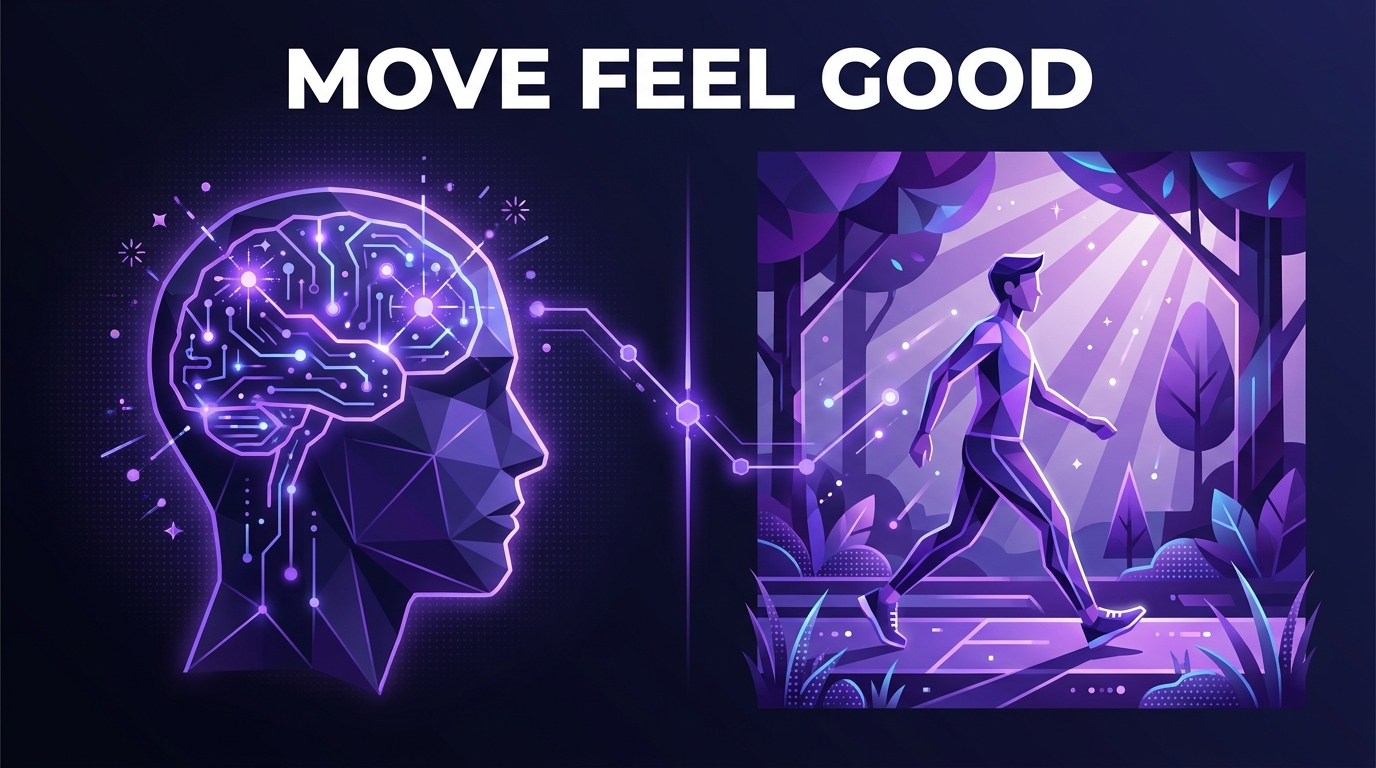
You can look up any fitness benefit and find a study for it. Exercise and mental health, though, has an unusually deep pile of evidence — comparable to what pharmaceutical trials produce. And the conclusion is remarkably consistent: regular moderate movement measurably lowers anxiety, improves sleep, and is something many clinicians now suggest alongside (not instead of) medical care for mild stress.
What happens in your brain after 20 minutes
Endorphins and endocannabinoids release during sustained activity; they blunt pain and create the calm, slightly elevated feeling people call the post-workout glow.
Brain-derived neurotrophic factor (BDNF) rises with aerobic movement. Think of it as fertilizer for neurons — it supports the growth of connections in the hippocampus, the region associated with mood regulation and memory.
Stress hormones drop. Adrenaline and cortisol, elevated by deadlines and doom-scrolling, get consumed by physical effort instead of stacking up harmlessly in the bloodstream.
None of this requires an elite performance. A brisk 20-minute walk has been shown in several trials to produce measurable mood improvement within the same day.
Anxiety, in particular, responds well
Anxiety is partly a body state — racing heart, tight chest, restless energy. Exercise is, essentially, a rehearsal of those sensations in a controlled setting: you raise your heart rate, breathe hard, then calm down on purpose. That repeated cycle teaches the nervous system that activation is survivable, which lowers the baseline sensitivity of the alarm system over weeks.
Sleep: the relay through which exercise lights up mood
Movement deepens slow-wave sleep, and slow-wave sleep is when the brain clears waste and calibrates emotional regulation. People who move more sleep more continuously; people who sleep better feel less anxious the next day; feeling less anxious makes it easier to move. Exercise lights up that wheel for free.
Realistic rules for a busy brain
Movement counts in any form. Vacuuming, cycling to the store, and dancing in the kitchen all trigger the same chemistry — "gym or nothing" thinking is the enemy.
Ten minutes of outside beats an hour of side-scrolling — sunlight plus movement is the fastest natural mood regulator we know of.
Schedule it like a medicine. Set times matter more than durations: a person who moves every day at 7 a.m. will out-benefit someone doing longer random sessions.
Pair it with play. This is where gamified fitness shines — coins, leaderboards, and AR hunts remove the decision friction from the "should I?" moment, which is exactly where anxious brains stall.
When exercise is not enough
Movement is powerful, but it is a companion, not a cure-all, for clinical depression or an anxiety disorder. If low mood, insomnia, or panic persist for more than a couple of weeks or interfere with your daily life, involve a professional. The best framing: exercise builds the soil; therapy and treatment plant the seeds.
The take-away
Your brain is an organ that runs on the chemistry exercise adjusts. Twenty minutes a day, or the walk you were about to skip, is a medicine with no copayment — and the hardest part, as always, is opening the door.